Updated: 4 November 2026. When people hear the word technology, they often think of a smartphone, computer, the internet or artificial intelligence. But technology is much broader. It is involved in water treatment, electricity systems, mobile payments, medical imaging, navigation, construction, agriculture and the way businesses coordinate their work.
Technology is the practical application of knowledge, tools, methods and systems to solve problems, perform tasks or create something useful. It is not just a device. It combines people, knowledge, data, hardware, software, networks, energy and processes. When these elements work together, they create services, products and new opportunities.
Key takeaways
- Technology is a way of solving problems, not simply owning devices.
- Hardware, software, data, networks and energy work together to make digital systems function.
- AI, cloud computing, the Internet of Things, robotics, biotechnology, semiconductors and quantum technologies are shaping current development.
- Benefits come with risks: cybercrime, misinformation, privacy loss, bias, changing jobs and unequal access to connectivity.
- Somalia can apply technology to agriculture, livestock, health, education, water, energy, logistics and business.
- The future will reward people who combine technical understanding with critical thinking, creativity, ethics and continuous learning.
1. What is technology? A simple definition
Technology is the use of knowledge and practical methods to achieve a result. Sometimes the result is a physical object, such as a pump, medical device, engine or construction tool. Sometimes it is an intangible service, such as a payment platform, digital map, inventory system or software application.
Consider a farmer who uses a solar-powered pump, a soil-moisture sensor and a weather application. The value is not in owning several devices. It is in using information and equipment to manage water, time and costs more effectively. Technology can be simple or advanced, mechanical or digital, and it does not always require an internet connection.
Wheels, irrigation systems, refrigeration, measuring instruments and modern building methods are all forms of technology. Computers and the internet are only part of the larger picture.
2. How does technology work?
Imagine sending a message from your phone. You type into an application; the phone converts the message into digital information; a mobile or Wi-Fi network transmits it; a server or cloud service processes it; and the other person's device receives and displays it. A simple action depends on hardware, software, networks, data, electricity and security procedures.
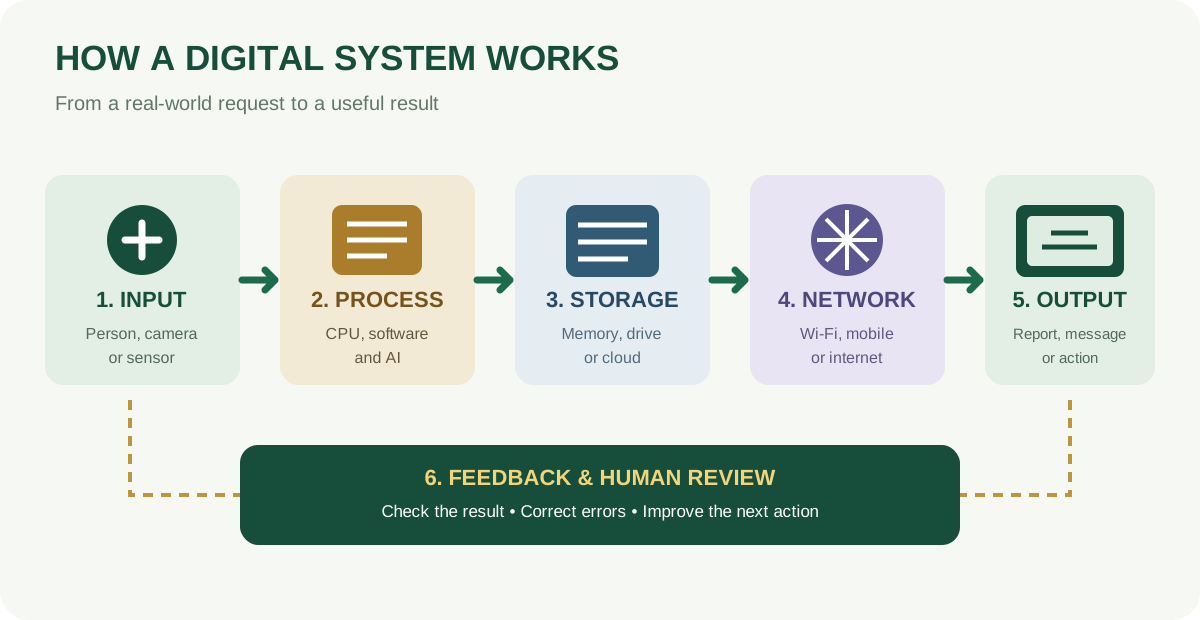
Many digital systems follow a similar cycle:
- Input: a person enters information, a camera captures an image, or a sensor measures temperature.
- Processing: a processor or server calculates, sorts, checks or analyses the information.
- Storage: data is kept in device memory, a drive, a server or cloud storage.
- Transmission: a network sends information to another device or data centre.
- Output: the system produces a screen, report, message, sound, alert or machine movement.
- Feedback: a person or system checks the result, corrects an error or begins another task.
A computer or AI system does not independently know what is correct. It follows a design, instructions, data and rules. Poor data or an unclear request can produce a poor result. People who understand the task, verify information and evaluate outputs remain essential.
3. The core components of modern technology
Hardware
Hardware is the physical equipment: phones, laptops, servers, processors, memory, storage drives, cameras, routers, sensors and machines. A processor executes instructions; RAM temporarily holds information in active use; and long-term storage keeps files and applications.
Software
Software tells hardware what to do. An operating system such as Android, iOS, Windows or Linux manages a device and its applications. Apps perform specific tasks such as messaging, accounting, design, payments or stock management. Good software should be useful, stable, secure and understandable.
Data
Data may be text, numbers, images, sound, location information, business records or sensor measurements. Useful data should be accurate, relevant, timely and collected lawfully and ethically. A large amount of unreliable data is not an asset; it can create mistakes.
Networks and the internet
Networks connect devices so they can exchange information. Wi-Fi connects nearby devices, mobile networks provide wider coverage, and fibre-optic cables, undersea cables, data centres and satellites are part of global connectivity. The internet is not one giant computer; it is a network of networks that communicate using shared technical standards.
Energy and infrastructure
Digital services depend on electricity, cooling, secure buildings, maintenance and reliable connectivity. Servers and data centres need energy and cooling. This is why technology development is not only about software; it also relies on infrastructure and skilled people.
4. How does the internet work?
The internet connects millions of networks and devices. When you enter a website address, your device uses DNS to find the server's IP address. Your browser then establishes a connection and communicates using protocols such as HTTPS. The information is transmitted in small packets across networks, reassembled by your browser and displayed as a page.
HTTPS encrypts the connection between your browser and the website while information is in transit. It helps protect data and authenticate the server, but a padlock alone does not prove that a business or message is trustworthy. You should still check the domain, reputation and request.
Bandwidth, latency, network coverage, service quality and price all matter. A very fast but unreliable connection may be less useful than a moderate, stable connection. Online education, video communication and digital health services need dependable connectivity.
5. Artificial intelligence (AI)
Artificial Intelligence (AI) is a field of computer science that develops systems capable of tasks commonly associated with human intelligence, such as understanding language, recognising images, predicting outcomes, summarising information and supporting decisions. AI is a family of techniques, not one product.
Machine learning and deep learning
Machine learning allows a system to learn patterns from examples rather than relying only on manually written rules. A model might learn to recognise an object after being trained on many labelled images. Deep learning uses multi-layer neural networks and is particularly useful in image, audio and language tasks.
Generative AI
Generative AI can create text, images, audio, video or code from instructions called prompts. A chatbot can draft or summarise text; an image model can create an illustration; and coding assistants can suggest program structures. However, AI can produce information that sounds convincing but is wrong. This is often called a hallucination. Important outputs must be checked, particularly in health, law, finance, engineering and news.
AI agents
AI agents are systems designed to plan steps, use digital tools, work with information and complete defined tasks. An agent might prepare a draft report or organise information from approved files. Work involving money, private data, contracts, health or consequential decisions needs human approval and supervision. The organisation or person using the system remains responsible.
Stanford's 2026 AI Index reports that industry produced more than 90% of notable frontier models in 2025 and that organisational AI adoption reached 88% in the report's dataset. It also records 362 documented AI incidents in 2025, up from 233 in 2024. The lesson is that stronger capabilities need stronger safety, transparency and accountability. Read the Stanford AI Index 2026.
6. Cloud computing
Cloud computing provides services such as storage, servers, databases and software over the internet. Instead of building all the infrastructure themselves, organisations can rent computing capacity from a provider. A small business might use cloud email, file sharing, a website, customer records or stock management.
Cloud services still have costs and risks. They depend on connectivity and electricity. Users should understand who controls the data, where it is stored, who can access it, how backups work and how information can be exported if the provider changes.
7. The Internet of Things (IoT)
The Internet of Things connects physical devices that contain sensors, software and network connectivity. Examples include electricity meters, warehouse temperature sensors, soil-moisture devices, vehicle GPS trackers and water-leak alerts.
In a warehouse storing medicine or food, a sensor can measure temperature and alert a manager when conditions move outside the approved range. This can shorten the time needed to detect a problem. The sensor must still be calibrated, maintained and checked. IoT devices also need secure passwords, updates and restricted access.
8. Robotics and automation
A robot is a machine designed to perform a defined task using sensors, software and movement components. Industrial robots can weld, paint, lift or repeat precise operations. Other specialised robots support healthcare, logistics, cleaning, inspection and delivery.
Automation is broader than robotics. Software can automatically issue a low-stock alert, prepare a monthly report or process a routine approval without a physical robot. Good automation reduces repetitive work, but it needs a clear process, monitoring and a plan for failures.
The International Federation of Robotics reported 603,000 new industrial robot installations worldwide in 2025 and an operational stock of 5.079 million industrial robots. This shows that industrial automation is already part of modern production. See the World Robotics 2026 update.
9. Other technologies shaping the future
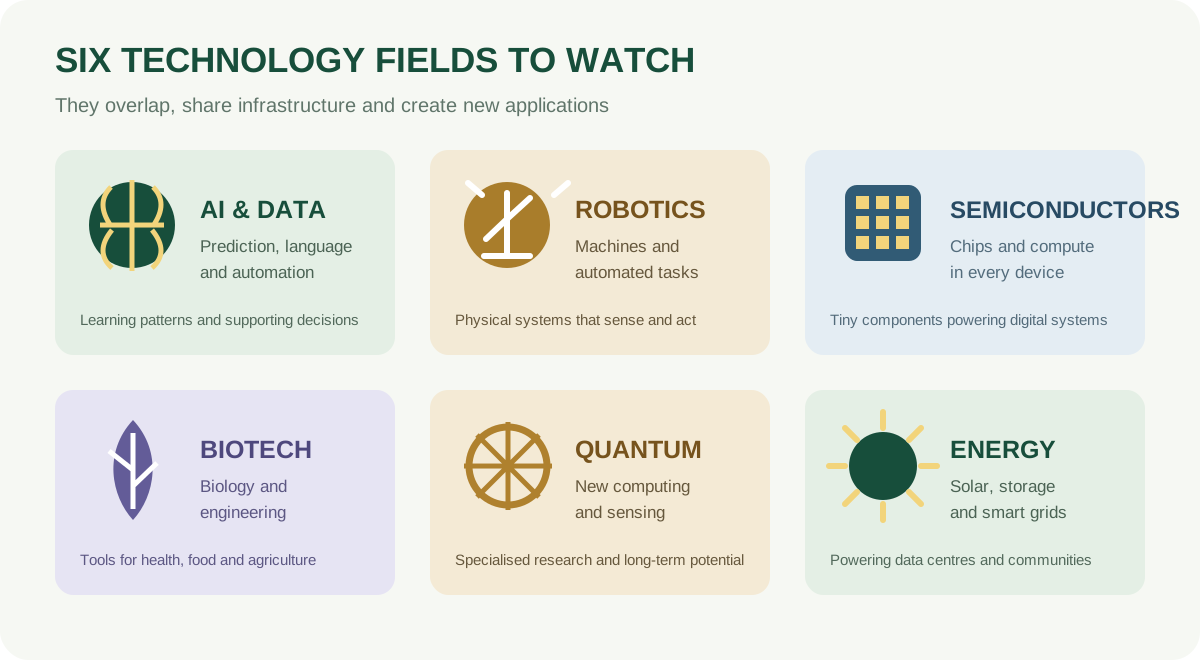
Semiconductors and computer chips
Semiconductors are materials used to make electronic chips. Chips are found in phones, vehicles, routers, medical equipment, servers and industrial machines. AI has increased demand for powerful processors and high-speed memory. Chip manufacturing depends on specialised research, equipment, materials, water, electricity and skilled labour, making it an economic and strategic issue.
Quantum computing and sensing
Quantum computing uses principles of quantum physics to address certain specialised computational problems. Traditional computers use bits represented as 0 or 1; quantum computers use qubits with different physical properties. This does not mean quantum machines are faster for every task. Potential applications include selected problems in chemistry, materials science and optimisation, but major engineering challenges remain.
Quantum sensing uses quantum effects to make highly sensitive measurements. Stanford's 2026 Emerging Technology Review discusses AI, biotechnology, robotics, semiconductors, energy, space, cryptography and quantum technologies as important fields to understand. Read the Stanford Emerging Technology Review 2026.
Biotechnology and synthetic biology
Biotechnology combines biology and technology to improve healthcare, agriculture, food production, environmental services and manufacturing. Examples include diagnostic tests, crop research, industrial enzymes and tools for disease detection. These developments require rigorous safety, ethical oversight, health-data protection and regulation.
Renewable energy technology
Solar power, wind power, batteries, smart grids and energy-management systems support a more flexible energy system. Solar equipment combined with storage and monitoring can help a service facility maintain power. Technology can also identify electricity losses and forecast demand. Planning must consider maintenance, battery life, recycling, electrical safety and lifetime cost.
Satellite technology
Satellites support communications, navigation, weather forecasting, earth observation and environmental monitoring. Satellite data can help monitor drought, vegetation, coastal change, flooding and urban growth. Data alone is not enough: people need the skills to analyse it and turn it into useful decisions.
10. 5G, fibre and the future of connectivity
5G networks are designed to provide higher capacity, lower latency and support for many connected devices. Fibre-optic cables transmit information using light and are important for connecting cities, data centres and network infrastructure. Communication satellites can help connect some places where ground infrastructure is limited.
No single network is the best solution everywhere. Dense cities may need 5G and fibre, while remote areas may require a combination of mobile, wireless or satellite links. Decisions should consider need, price, coverage, maintenance and available equipment.
On 3 November 2026, the ITU estimated that 6.3 billion people—76% of the world's population—use the internet, while 2 billion remain offline. Internet use was estimated at 93% in high-income countries but only 32% in low-income countries. This digital divide shows why affordability, infrastructure and skills matter alongside innovation. See the ITU Facts and Figures 2026 release.
11. How technology is changing work and skills
Technology changes tasks, but its effects differ between occupations. Repetitive activities with predictable steps may be easier to automate. Work requiring human understanding, accountability, contextual judgement, practical skill, creativity and negotiation may still need people to lead or supervise.
AI can help draft documents, summarise information, analyse spreadsheets, translate text and explore ideas. Workers must still verify accuracy, protect confidential information and respect copyright. People who combine professional knowledge with responsible use of technology may be better prepared than those who only know how to operate a tool.
Skills worth developing
- Digital literacy: using computers, files, email and online services safely.
- Data literacy: understanding numbers, charts, evidence and data quality.
- AI literacy: understanding capabilities, limits and verification.
- Cybersecurity awareness: recognising scams and protecting accounts.
- Communication: writing clearly, collaborating and presenting information.
- Problem-solving: defining a problem, finding causes and testing solutions.
- Continuous learning: adapting to tools and methods as they change.
12. Technology risks everyone should understand
Cybersecurity and online fraud
As more services move online, accounts, devices and information need protection. Risks include phishing, malware, identity theft, payment fraud, data breaches and service attacks. Use unique passwords, enable multi-factor authentication, update devices, check website addresses and never share passwords or verification codes.
Deepfakes and misinformation
AI can generate realistic audio, images and video. This can help creative work, but it can also make impersonation easier. Before sharing a surprising clip, check its origin, look for independent sources, verify the date and context, and be cautious about urgent requests for money or private information.
Privacy and personal data
Do not enter identity documents, medical information, contracts, financial details or confidential work data into unfamiliar AI tools or websites. Understand what is collected, who can access it and whether it can be deleted. Organisations should collect only necessary data, restrict access and maintain retention and deletion procedures.
Bias, mistakes and accountability
AI can learn patterns from biased data, so its results are not automatically fair or correct. Systems used in recruitment, lending, healthcare or public services need testing, explanation and oversight. The person or organisation using the system remains responsible for consequential decisions.
Jobs and the digital divide
Some tasks and roles may change, some may shrink and new ones may appear. People without affordable internet, electricity, devices or training risk missing new opportunities. Education, skills development and infrastructure should advance alongside the technology itself.
13. Technology opportunities for Somalia
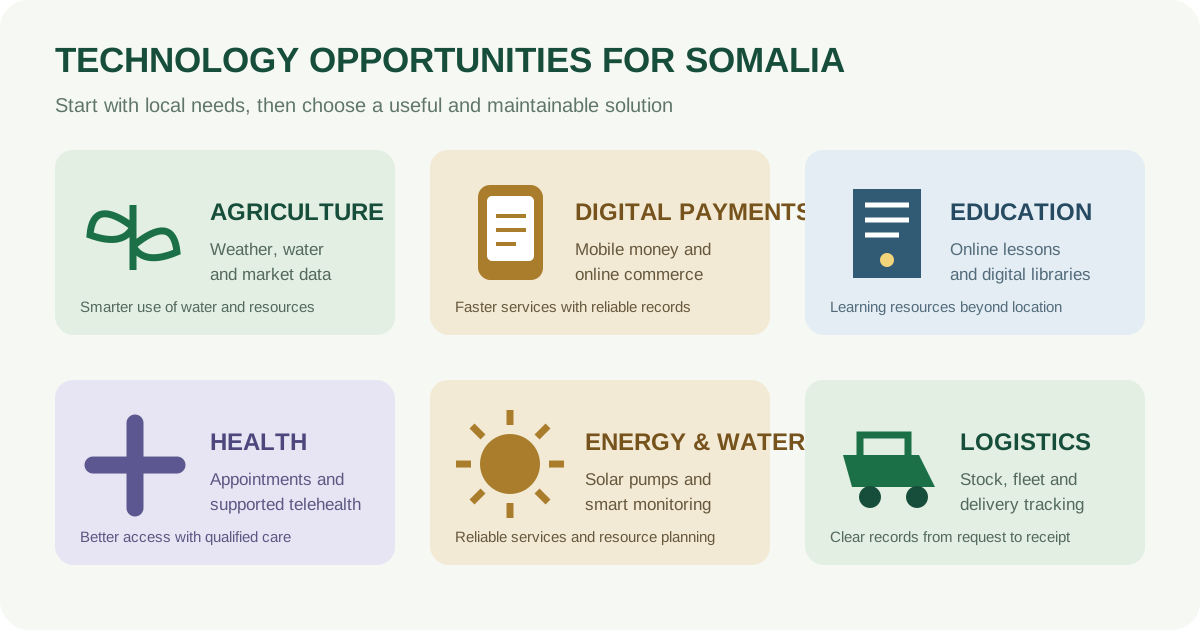
Somalia can benefit by applying technology to practical needs. The priority should not always be the newest equipment; it should be a solution that works, is affordable, maintainable and suited to local conditions.
Agriculture and livestock
Farmers can use weather information, rainfall data, satellite imagery, soil-moisture sensors, solar irrigation and digital markets. Livestock communities can benefit from animal-health information, drought alerts, water data and market services. Digital tools should complement local knowledge and qualified advice, not replace them.
Healthcare and public services
Telemedicine may help some people consult health professionals without long travel, when the service and connectivity are appropriate. Digital health records can improve access to patient information, appointments and medicine inventories. Medical decisions still require qualified health professionals; a chatbot is not a doctor.
Education and knowledge
Online courses, digital libraries, video lessons, practice assessments and multilingual learning resources can expand access. Good online education requires structured lessons, examples, exercises, feedback and assessment—not just videos. Resources should work on phones and under limited connectivity where possible.
Business, payments and financial services
Mobile payments, digital transfers, online accounting and e-commerce can simplify business. Organisations should use legitimate services, record transactions, protect customer information and understand fees and dispute procedures. Faster payment does not replace accurate bookkeeping and trust.
Water, energy and construction
Solar pumps, smart meters, leak sensors, building information modelling, design software and maintenance systems can support planning and resource management. However, construction, electrical and water designs still need qualified technical review. Software does not replace engineering standards or safety obligations.
Logistics, transport and warehouses
Barcodes, inventory software, GPS, fleet records and dashboards help organisations track stock, orders, dispatches and deliveries. Information must be entered promptly and checked. A useful system connects requests, approvals, purchasing, storage, transport and proof of delivery.
Readers interested in practical digital skills can explore Digital Productivity & Office Tools or Project Management Fundamentals at Waxbarasho. These are examples of learning pathways, not requirements for every profession.
14. Energy: why AI and data centres need electricity
Cloud and AI services may appear invisible, but they depend on data centres filled with servers, chips, cooling systems, backup power and network connections. More computing can mean greater demand for electricity and cooling.
The International Energy Agency projects that electricity consumption by data centres overall could rise from about 485 TWh in 2025 to around 950 TWh by 2030, close to 3% of global electricity use by that year. This is a projection, not a guaranteed outcome. It shows that AI development depends on power, networks, equipment and environmental planning. Read the IEA's 2026 analysis of energy and AI.
Innovation needs to be balanced with affordable electricity, water use, emissions, equipment recycling and community needs. Future technology should also be sustainable.
15. What could technology look like in the next 5 to 15 years?
No one can predict every development, but several directions are visible:
- AI integrated into work: more software will include assistants for summarising, analysis, translation and connected tasks. Human verification will remain essential.
- More specialised robots: factories, warehouses, agriculture, healthcare and selected services may use more robotics where cost, safety and maintenance make sense.
- Smaller and more capable devices: chips, sensors and edge computing may process information closer to where it is collected.
- More advanced cybersecurity: security systems will need to detect new threats while protecting identity, data and critical services.
- Energy technologies: solar, storage, smart grids and energy management will matter for data centres and digital growth.
- Biotechnology and medical devices: diagnostics, monitoring tools and specialised treatments may continue to advance under strong safety oversight.
- Quantum technologies: quantum computing and sensing may serve specialised applications, but the timing and scale of their commercial impact remain uncertain.
- Wider connectivity: fibre, 5G and satellite services may expand access where affordability and infrastructure improve.
The future does not require everyone to become an AI engineer or robotics specialist. It will also need teachers, technicians, healthcare professionals, managers, business owners, engineers, legal professionals and service workers who understand how technology affects their work.
16. How to prepare for the future of technology
The best starting point is not to learn everything at once. Choose one problem or skill that interests you and build a foundation. Someone interested in data analysis can begin with spreadsheets, basic statistics and data quality. A future web developer can learn how websites work, then study HTML, CSS, JavaScript and databases. A logistics professional can develop skills in inventory systems, dashboards and process mapping. An engineering learner can explore CAD, BIM, estimating and technical documentation.
A practical 30-day learning plan
- Days 1–7: learn the basics. Understand hardware, software, the internet, files, email, account security and data handling.
- Days 8–14: choose one pathway. For example, AI literacy, spreadsheets and data analysis, coding, digital design, cybersecurity awareness or CAD.
- Days 15–21: build a small project. Create a data sheet, simple web page, design, report or work plan. Apply the knowledge instead of only watching lessons.
- Days 22–30: test and improve. Ask someone to review your work, correct errors, record what you learned and choose the next step.
Use AI as an assistant that proposes drafts, not as an unquestionable authority. Ask it to explain its steps, verify important facts and never share private information. When learning, combine notes, practice and a project that demonstrates your understanding.
17. How to distinguish useful technology from hype
News about a new AI model, robot or device does not mean that a solution is ready for widespread use. Some technologies are still research, some are pilots and others are commercial products with limitations. Before investing in or adopting a service, ask:
- What problem does it solve, and who has that problem?
- Is there evidence that it works in your situation?
- What are the initial, maintenance, connectivity, power and training costs?
- Who owns the data, and who can access it?
- What happens when the internet or service is unavailable?
- Can it be maintained locally, and are parts and skills available?
- How will you measure time saved, error reduction or user benefit?
Useful technology is not necessarily the newest or most expensive. It is technology that solves a clear problem, is affordable, understandable, maintainable, secure and measurable.
18. Conclusion: technology is a tool; knowledge is the guide
Technology is changing how people communicate, learn, work, trade, build, travel and manage resources. AI, robotics, cloud computing, IoT, chips, quantum technologies, biotechnology and modern energy systems can create major opportunities. But real progress also needs knowledgeable people, reliable electricity, affordable connectivity, trustworthy data, security and responsible governance.
Somalia and Somali communities can take part in this future. Practical solutions can begin with a stock-management system, digital lessons, reliable market information, solar irrigation, better-supported health services or a tool that makes a public service easier to use. Innovation does not always begin with a large building or expensive laboratory. It can begin with someone who understands a problem, tests a solution, learns from mistakes and improves it.
The most important question is not only, “What new technology is coming?” It is: “What can we learn, build and improve with it for the benefit of people?” People who understand the basics, protect privacy, check information, work with others and keep learning can help shape technology for positive change.
Key points to remember
- Technology combines knowledge, tools, software, data, networks, energy and people.
- The internet moves information across connected networks; cloud computing provides remote storage and computing services.
- AI can support writing, translation and analysis, but outputs must be checked.
- Robotics, chips, biotechnology, quantum technologies, modern energy and satellites are shaping future development.
- Cybersecurity, privacy, bias, misinformation and changing work patterns must be managed responsibly.
- Somalia can apply technology to agriculture, livestock, healthcare, education, water, energy, logistics and business.
- Digital foundations, critical thinking and continuous learning are valuable across professions.
Sources and further reading
- Stanford Institute for Human-Centered AI – 2026 AI Index Report. AI capabilities, adoption and documented incidents.
- International Telecommunication Union – Facts and Figures 2026, 3 November 2026. Global internet use and di