Updated: 3 November 2026. Making money online is possible, but it is rarely instant and it is never guaranteed. A reliable online income usually comes from one of three things: providing a useful service, selling something valuable, or building an audience that trusts your work. The internet changes where you find customers; it does not remove the need for skill, effort, honesty, delivery and good financial decisions.
This guide explains seven realistic ways to earn online, how to choose one that fits your circumstances, how to build a first offer, and how to use a 90-day plan to test an idea without spending heavily. Platform rules, country availability, payment methods and age requirements can change, so check the official terms before joining any service.

1. Freelance services: sell a skill and a clear result
Freelancing means providing a defined service to a client for an agreed fee. It is often the most direct starting point because you can begin with a skill you already have, build a small portfolio and improve through feedback. Examples include writing and editing, translation, graphic design, presentation design, video editing, website updates, spreadsheet formatting, data organisation, research assistance, bookkeeping support where qualified, and social-media content preparation.
Do not advertise yourself as someone who can do everything. Choose one service and describe the result. For example: “I will format a 10-page report into a clean, consistent document,” or “I will edit five short videos with captions and clear titles.” A specific offer is easier for a client to understand, compare and approve.
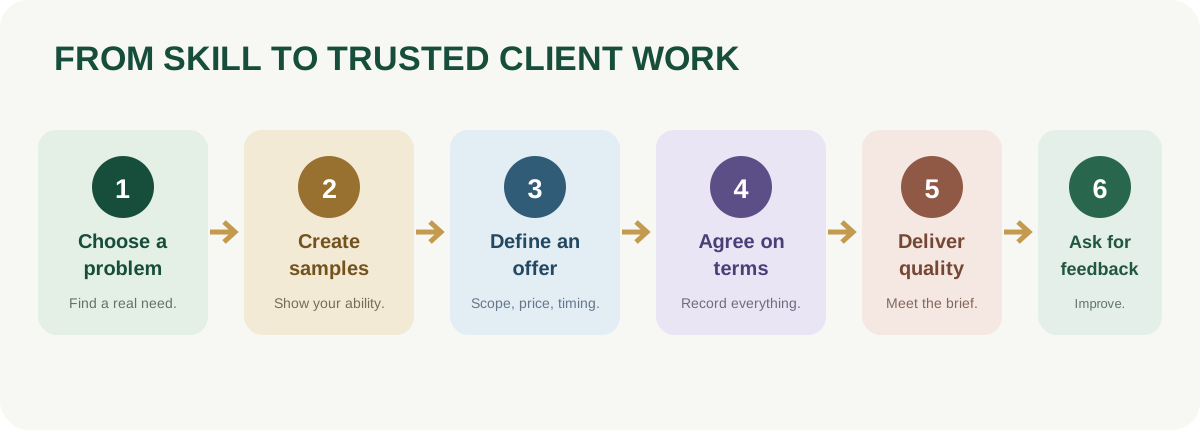
How to start
- Choose one skill. Pick something you can demonstrate, not simply something that sounds popular.
- Identify one customer type. Think of small businesses, community organisations, educators, local shops, researchers or creators who might need that service.
- Create three samples. Make sample work using fictional information or material you have permission to use. Label practice work honestly; do not present it as paid client work.
- Package the offer. State exactly what the client receives, the file format, delivery time, number of revisions and what is outside the scope.
- Agree on terms before starting. Confirm the price, deadline, payment method, responsibilities and approval process in writing.
For many beginners, the strongest portfolio is not a long list of certificates. It is three clear examples that show the quality of the result. Never use confidential files, client records or personal information in a public sample.
2. Remote employment and contract work
Online income does not have to mean running a personal business. Some organisations hire remote employees or contractors for customer support, software development, design, communications, research, administration, project coordination, accounting, sales and technical support. These opportunities may offer more predictable work than one-off freelance jobs, but they can involve interviews, fixed hours, performance requirements, local employment rules and formal contracts.
Prepare a focused CV and a short portfolio that matches the role. Read the job description carefully, tailor your application to the essential requirements, and use a professional email address. Check the employer’s real website and domain, verify who is contacting you, and request written details about duties, working hours, compensation, currency, payment dates and contract terms. A genuine employer should be able to explain the work clearly.
Be cautious of messages that promise unusually high pay for simple tasks, offer employment without a meaningful interview, or demand a registration, training, equipment or release fee before you can begin. A job should not require you to send money to unlock your wages.
3. Digital products: make something useful that can be sold repeatedly
A digital product is a file, resource or tool that a customer can receive online. Examples include original workbooks, study planners, checklists, printable materials, presentation templates, spreadsheet trackers, design assets, short guides, reference sheets and educational resources. Unlike a service, a digital product can be sold more than once without repeating all the creation work, although it still needs marketing, customer support, updates and quality control.
The key is to create something that solves a specific problem. A generic “business guide” may be difficult to sell. A well-designed stock-count template for a small shop, a clear household budget worksheet, or a practical project checklist has a defined audience and purpose.
A simple product-development process
- Speak with a few potential users or study questions people repeatedly ask.
- Choose one small problem that can be solved with a downloadable resource.
- Create an original first version and test it yourself.
- Ask a few people from the intended audience to test it and explain what is unclear.
- Write an honest product description, show sample pages, state the file format and explain how customers receive support or updates.
Only sell work you created or have permission to distribute. Check licences for fonts, photos, illustrations, software, templates and other third-party materials. Do not copy paid courses, books, brand logos or another creator’s templates and sell them as your own.
4. Online teaching, tutoring and skills training
If you have strong knowledge of a subject, you may be able to teach it online through tutoring, small-group lessons, workshops or recorded learning materials. Potential subjects include languages, school subjects, software basics, professional writing, design tools, mathematics, exam preparation and practical workplace skills. Teach only within your competence, and be honest about your qualifications.
Start with one lesson that has a clear learning outcome. Prepare a short outline, an example, a practice activity and a way for learners to ask questions. A useful lesson helps the learner do something, not just listen to a long presentation. Test the audio, internet connection, slides and time plan before the session.
Protect both teacher and learner privacy. Use appropriate meeting settings, avoid sharing personal contact details publicly, and follow the safeguarding and supervision rules that apply to the learner’s age and location. If you are not qualified to provide professional advice in a regulated area, do not market a lesson as a substitute for that professional service.
5. Content creation: build useful content and an audience
Content creators publish videos, articles, podcasts, newsletters, tutorials or other material that an audience finds useful or entertaining. Potential revenue sources include advertising, sponsorships, subscriptions, paid products, events and services. However, audience-building normally takes time. A new channel or blog may earn nothing for months, and views do not automatically translate into reliable income.
Choose a clear subject and audience. Examples include learning a language, explaining a technical topic, documenting local history, reviewing tools you have genuinely tested, teaching a practical skill or explaining a community issue with reliable sources. Publish consistently enough to learn from feedback, but do not sacrifice accuracy just to post more often.
For advertising revenue, eligibility rules are specific. YouTube’s published full-ad-revenue pathway currently includes 1,000 subscribers and either 4,000 valid public watch hours from long-form videos during the previous 12 months or 10 million valid public Shorts views during the previous 90 days. The channel must also meet the programme’s other requirements, be in an eligible country or region, and comply with monetisation policies. The rules are described in YouTube’s official monetisation guidance.
Originality matters. YouTube says repetitive, mass-produced or reused material with little added value may be ineligible for monetisation. Using editing or AI tools does not remove the need for original research, commentary, teaching, analysis or creative work. Read YouTube’s channel monetisation policies before building a business around a channel.
For a website or blog, write for readers first. Explain a topic thoroughly, identify sources, make corrections when needed and add practical insight rather than rewriting other pages. Google’s people-first content guidance emphasises original, helpful and trustworthy pages, not material produced mainly to manipulate search rankings.
6. Affiliate publishing: recommend products transparently
Affiliate marketing means receiving a commission when someone buys through a trackable link you share. It can work for a specialist blog, product comparison page, tutorial channel or newsletter, but only when the audience trusts the recommendations. A link is not a business by itself: you need useful content, relevant visitors, accurate product information and a clear explanation of why you recommend something.
Start with a subject you understand. Test products where possible, explain limitations as well as benefits, and never invent personal experience or make claims you cannot support. Avoid filling pages with links to unrelated products. Choose programmes only after checking eligibility, country availability, payment thresholds, return rules, cookie windows and the conditions under which a commission can be cancelled.
Disclose financial relationships clearly and close to the recommendation. For example: “We may earn a commission if you buy through this link; this does not change the price you pay.” The US Federal Trade Commission explains that affiliate relationships should be clear and conspicuous, and placed close enough to the recommendation and link for readers to understand the connection. See the FTC’s endorsement guidance. Other countries may have their own advertising and consumer-protection rules.
7. Online commerce: sell physical products with a real fulfilment plan
An online shop can sell locally made goods, clothing, accessories, books, household items, specialist products or made-to-order items. A seller may hold stock, produce goods after an order, or work with a fulfilment partner. Each model has different costs and risks. “Dropshipping” does not remove responsibility for product quality, delivery promises, refunds, customer service, customs requirements or consumer rights.
Before listing a product, calculate its full cost: purchase or production, packaging, delivery, payment processing, platform fees, returns, damaged items, advertising and customer support. The difference between the sale price and the product cost is not the same as net profit. Confirm that the supplier is reliable, the product description is accurate, and the delivery estimate is realistic. Start with a small test rather than buying a large amount of stock before you know whether customers want it.
Which path should you choose?
Do not try all seven at once. Compare your options using five questions:
- Skill: What can I already do to a useful standard, or learn with a realistic amount of practice?
- Problem: Who has a problem that this skill or product can solve?
- Proof: Can I show a sample, demonstration, lesson outline or product preview?
- Access: Can I legally use the service in my country and receive payments through an approved method?
- Time: Can I deliver reliably without neglecting study, health, family responsibilities or other commitments?
For someone starting with limited resources, a service is often easier to test than a shop with inventory. A digital product can be a sensible second step after you understand a repeated customer problem. Content and affiliate publishing can grow over time, but usually need a longer runway before meaningful revenue appears.
A practical 90-day plan
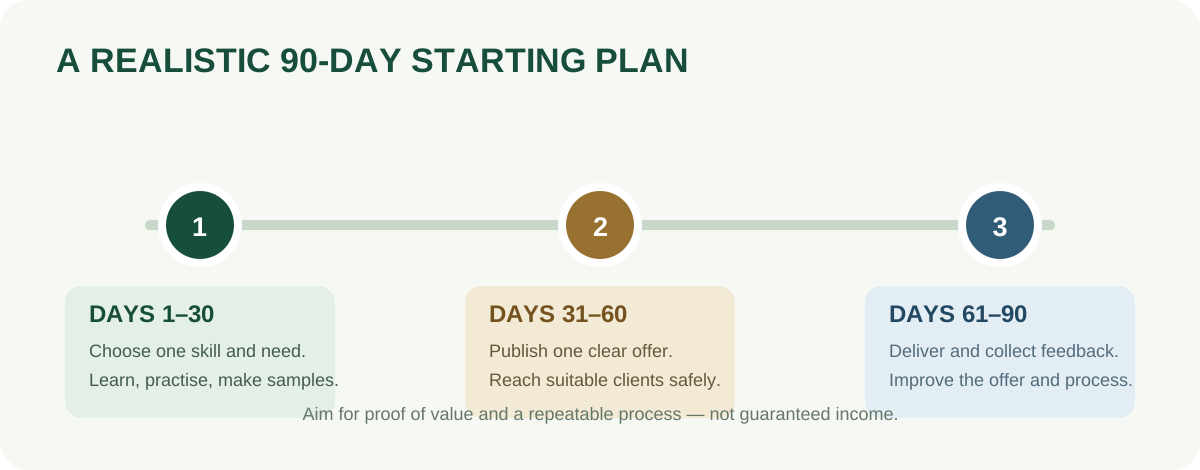
The purpose of the first 90 days is not to promise a particular income figure. It is to test whether you can create something useful, reach the right people, deliver reliably and understand the true costs.
Days 1–30: choose and prepare
- Choose one service, product or topic. Write down the specific audience and problem it addresses.
- Study the basics using reputable learning resources. Practise before charging for work you cannot yet deliver.
- Create three examples or a small prototype. Ask for feedback from people who understand the subject.
- Write a one-paragraph offer explaining the result, scope, delivery time and price or pricing method.
- Check age eligibility, local rules, payment access and platform fees before opening an account or accepting an order.
Days 31–60: test the offer
- Publish a simple portfolio or product page using accurate descriptions and original examples.
- Reach out respectfully to a small number of relevant organisations or potential customers. Personalise each message; do not spam people.
- Ask questions before quoting. Confirm the required result, deadline, file format, approval process and any revisions.
- For content projects, publish useful material on a manageable schedule and review what readers actually find helpful.
- Record responses, questions, time spent and expenses. Improve the offer based on evidence, not guesses.
Days 61–90: deliver and improve
- Complete agreed work on time and keep a copy of the approved brief and delivery record.
- Ask the customer for specific feedback and permission before displaying the work as a public portfolio example.
- Calculate net results after fees, transport, tools, refunds and other costs.
- Improve the part that caused the most difficulty: quality, communication, pricing, delivery or finding suitable customers.
- Continue only if the activity is lawful, safe, sustainable and genuinely useful to customers.
Write a clear first offer
A simple offer can follow this structure:
I help [type of customer] achieve [specific result] by providing [service or product]. The package includes [deliverables], is normally completed within [time], and costs [price or agreed quotation]. Before work begins, we confirm the scope, files, payment terms and any revisions in writing.
Example: “I help small organisations prepare clearer reports by formatting and proofreading documents of up to 10 pages. The package includes one formatted document and one correction round. The final deadline and quotation are agreed after reviewing the source file.”
This is more credible than a vague claim such as “I can do all online work” or “I guarantee that your business will grow.” Describe what you control: your process, the deliverable and the agreed deadline. Do not guarantee outcomes that depend on the customer, search engines, advertising systems or market conditions.
Payments, country access and record-keeping
Before committing time to a marketplace or payment provider, check whether it supports your country, whether it can pay out to a method you can legally use, what identity checks are required, which currencies are supported, and what fees or minimum withdrawal amounts apply. Availability can differ between countries and services. Check the provider’s official country list, such as Stripe’s global availability page, rather than relying on an old social-media post or another person’s account.
Never use a false address, borrowed identity or someone else’s financial account to get around a restriction. Do not send identity documents or banking details to an unknown person in a chat. Keep invoices, receipts, contracts and a record of payments and expenses. Tax, registration and consumer-protection obligations depend on where you live and what you sell; seek guidance from an appropriate local authority or qualified adviser.
Age rules and responsible participation
Online platforms set their own minimum ages and account rules. For example, Upwork requires users to be at least 18 or the age of majority in their country, whichever is older. Fiverr states that users aged 13–17 may use the service only through an account owned by a parent or legal guardian, with permission and the required supervision; its rules also prohibit users under 13. Google says AdSense account holders must be at least 18, while an under-18 publisher may have a parent or guardian apply through the adult’s own account and receive the payments. These are platform rules, not permission to ignore local child-work laws.
If you are under 18, focus first on learning, practice projects and age-appropriate activities. Involve a parent or legal guardian wherever the law or platform requires it. Do not create an account using a false birth date, borrow an adult’s identity, sign contracts independently where you are not legally allowed, or share private information with strangers. Review each provider’s current policy because rules can change.
Scams to avoid: never pay to unlock your earnings
Be especially cautious of unexpected WhatsApp, Telegram, text or social-media messages offering easy money for liking posts, rating products, “optimising” listings or completing repetitive tasks. Some task scams show fake balances, pay a small amount to build trust, then ask you to deposit your own money to unlock the next task or withdraw supposed earnings. The Federal Trade Commission warns consumers not to pay money to get paid or to get a job. Read the FTC’s task-scam advice.
- Do not pay a registration, activation or withdrawal fee to receive wages or commissions.
- Do not deposit money to unlock tasks, rankings, commissions or a fake account balance.
- Reject offers that promise guaranteed high income for almost no work.
- Be wary of fake cheques, overpayments, gift-card requests and pressure to move a conversation off a trusted platform.
- Do not provide passwords, one-time codes, remote access to your device or private identity documents to an unverified contact.
- Search for the organisation independently and verify the job, contract and payment process through official contact details.
Common mistakes that stop progress
Starting too broadly: one well-defined offer is easier to test than ten unrelated services. Copying other people’s work: copied designs, articles, videos and templates can lead to copyright complaints and loss of trust. Buying tools too early: use free or low-cost tools until you have evidence that customers need your offer. Ignoring costs: revenue is not profit. Chasing every trend: a trend is useful only when it fits an audience and a genuine capability. Using AI without review: AI can assist with planning, drafting and editing, but you remain responsible for facts, quality, privacy, copyright and the final work.
Key takeaways
- Online income comes from solving a real problem, not from secret shortcuts.
- Choose one route first: services, remote work, digital products, teaching, content, affiliate publishing or online commerce.
- Show proof through original samples and describe a specific deliverable.
- Check platform eligibility, country support, payout rules and fees before investing time or money.
- Use written scopes, honest descriptions, clear affiliate disclosures and accurate records.
- Protect your privacy and never pay to unlock a job, task or supposed earnings.
- For anyone under 18, follow platform age rules, local laws and required parent or guardian supervision.
- Use the first 90 days to learn and test a repeatable process. No method guarantees income.
Official sources and further reading
- Upwork: who is eligible to join and use the platform
- Fiverr: account eligibility and parent/guardian rules
- Google AdSense: age requirements
- YouTube: monetisation eligibility and requirements
- YouTube: channel monetisation policies
- Federal Trade Commission: how to spot and avoid task scams
- Federal Trade Commission: affiliate and endorsement disclosures
- Google Search Central: helpful, reliable, people-first content
- Stripe: check global country availability
Editorial note: Platform terms, local laws, monetisation thresholds and payment availability can change. The official links above should be checked again before acting. This article provides general educational information, not a promise of income or individual legal, tax or financial advice.


